Cedar and the agents
Who Cedar, Sakura, Sequoia and Sapele are in Grove, what they do on their own and what they never do, how fast and how they are checked, and what Cedar remembers.
TL;DRAI summary
This chapter explains how Cedar, your AI copilot, and other agents work within Cypress to automate tasks and help you make decisions. They can act on their own based on rules you set, but they never handle critical actions like changing prices or accepting offers below a floor.
For: Everyone in Grove
In Cypress, Cedar is a copilot that helps you on the page you are on. In Grove it works on its own: it watches Cypress for your organization, brings you the decisions with the work done, and runs the routines you allow. Three more agents share the work, each named on the cards it brings.
| Agent | Role | What it brings |
|---|---|---|
| Cedar | Fleet Advisor | Answers, the brief, tasks, team memory, the routines (playbooks) |
| Sakura | Sales | Offers, listings, cars gone cold |
| Sequoia | Market | The quarter's plans, this week's plays |
| Sapele | Closing | Each closing step in its deal lane, Deal Setup, reminders |
What they do on their own
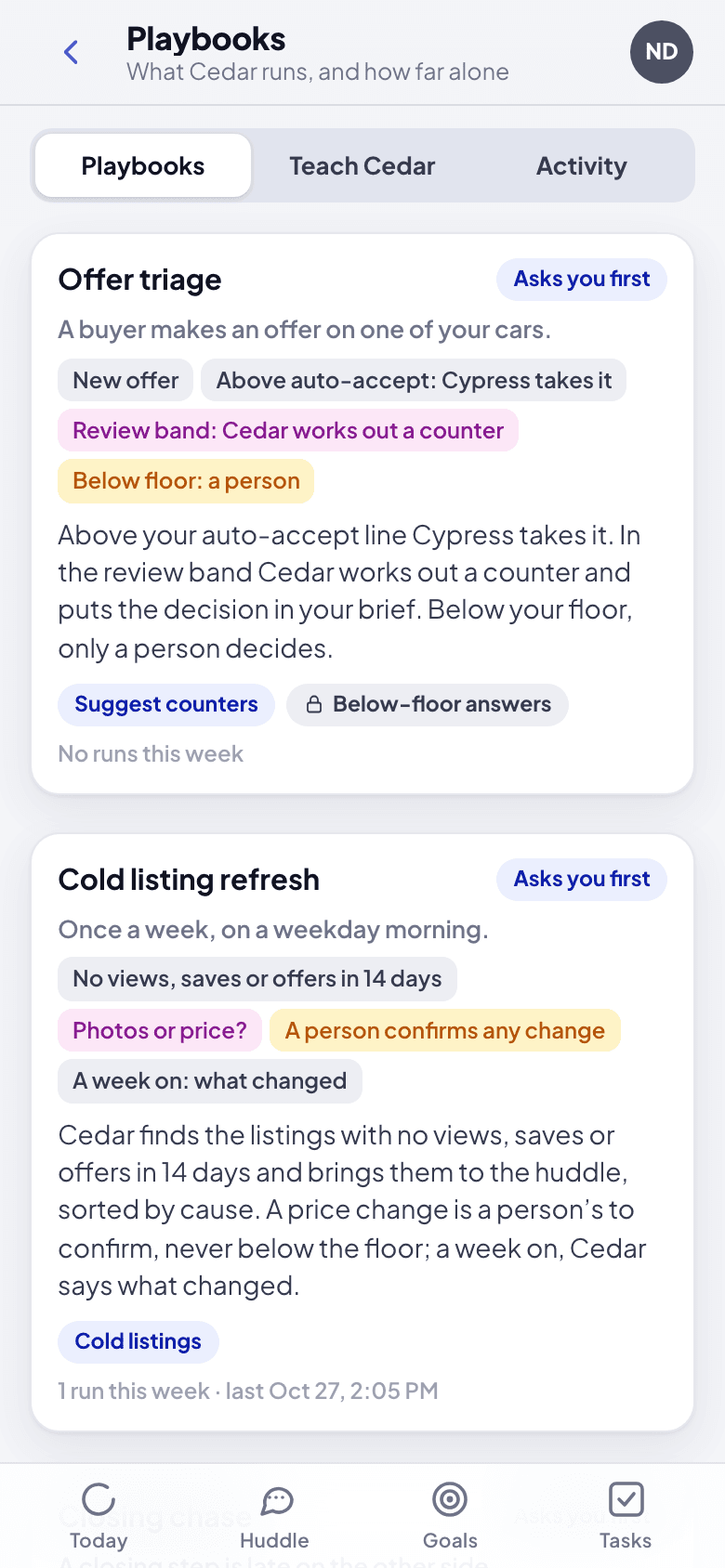
What an agent may do alone is set per rule in Teach Cedar, by an admin, a fleet manager or your Cypress Manager: Off, Watches (tells you in the brief), Asks (brings it with the work done, you confirm), Acts (does it and tells you after). Routines are grouped as playbooks, each with its steps, the rules it uses and how often it ran this week.
What they never do
- Set or change a floor, accept or counter below the floor, confirm money received: these are People only, whatever the levels say.
- Act on a card without your confirm, or confirm anything by voice.
- Say something was accepted, sent or signed unless Cypress said so.
- Guess. When Cedar is not sure, it makes a task for the person who can decide.
How they answer
- From Cypress, as you. Every number, name and status comes from Cypress, read with your role: an agent sees what you can see, no more.
- Short. One or two sentences, the recommendation then the number that matters; the card carries the detail.
- Fast. About two seconds. Cypress works the facts out (which offer is oldest, how late a step is, the order to answer in), so the model phrases them instead of working them out. When the main model is busy, a stronger backup answers, more slowly.
- Checked. Every answer goes through three checks (short, numbers from Cypress, no claims without proof), shown in Why Cedar said this. Cypress staff also benchmark Cedar on real questions before any change to its model, and review the answers worth a second look.
What Cedar remembers
| Layer | What it holds | Who sees it |
|---|---|---|
| The thread | The last messages of the conversation you are in | The thread's members |
| Your memory | What Cedar learned about you across threads (preferences, how you like answers) | You, in Profile, with Forget all |
| Team memory | What Cypress says about your organization, and facts your team taught | Everyone in it and your Cypress Manager |
| Lessons | Corrections Cedar follows, yours and your team's | You, and your team for team lessons |
| Earlier conversations | Searched when you ask about something said before | Only rooms you are in |
Grove glossary
Every word Grove uses, A to Z: places, cards, levels, agents, and the Cypress terms Grove brings with it.
Notifications and quiet hours
Everything that needs you lands in Grove's Inbox as it happens. The lock screen stays calm unless you choose more: direct messages, one brief each morning, at most two interruptions a day, never between 7 PM and 7 AM.