Inspections: self, AI & third-party
Every condition signal on a vehicle — your score, the ARVIS AI inspection, and uploaded reports — and how they reconcile.
TL;DRAI summary
This chapter explains how Cypress provides up to three condition scores for each vehicle — your self-reported score, an AI-powered inspection, and a third-party report. You'll understand what each score means and how they help buyers and guide pricing decisions.
For: Fleet Managers · Cypress Managers (ARVIS runs are CM-side)
One vehicle can carry up to three condition opinions, and the platform shows all of them rather than pretending there's one truth. This chapter explains the three-row score chip you'll see everywhere, and what stands behind each row.
The three rows
- Self — the Fleet Manager's own 1–5 score from onboarding. Fast, informed, and — being self-reported — the one buyers weight least.
- AI — the ARVIS inspection: the platform's vision engine reads the vehicle's photos, finds damage part by part (a scrape on the rear bumper, curbed wheels, a cracked lens), estimates repair cost, and grades on the same 1–5 industry scale. It also captures the practical facts: does it start, does it drive, tire depths, warning lights.
- MNH — a third-party report (Manheim-style condition report or an independent inspection) uploaded to the vehicle: the arms-length grade wholesale buyers trust most.
Running ARVIS
ARVIS runs are operator-side: a CM opens Run ARVIS on a vehicle with photos, and the inspection pipeline processes each image, marks findings on a schematic (front / rear / left / right / top), and totals damages into a grade and a repair estimate. A human technician can then review — adjusting severity, adding notes, or overriding the grade — and the override is recorded alongside the AI's original, never instead of it.
Sellers see the results read-only: your listing benefits from the inspection's credibility whether or not you agree with every line of it.
Third-party reports fetch themselves
When imported inventory references an external condition report, the platform fetches it automatically: the import queues a report fetch per vehicle, pulls the grade and the report's photos in, and the MNH row populates without anyone downloading PDFs by hand. The report's photos join the vehicle's gallery tagged by source, and the arms-length grade is on the listing from day one.
Inside an ARVIS run
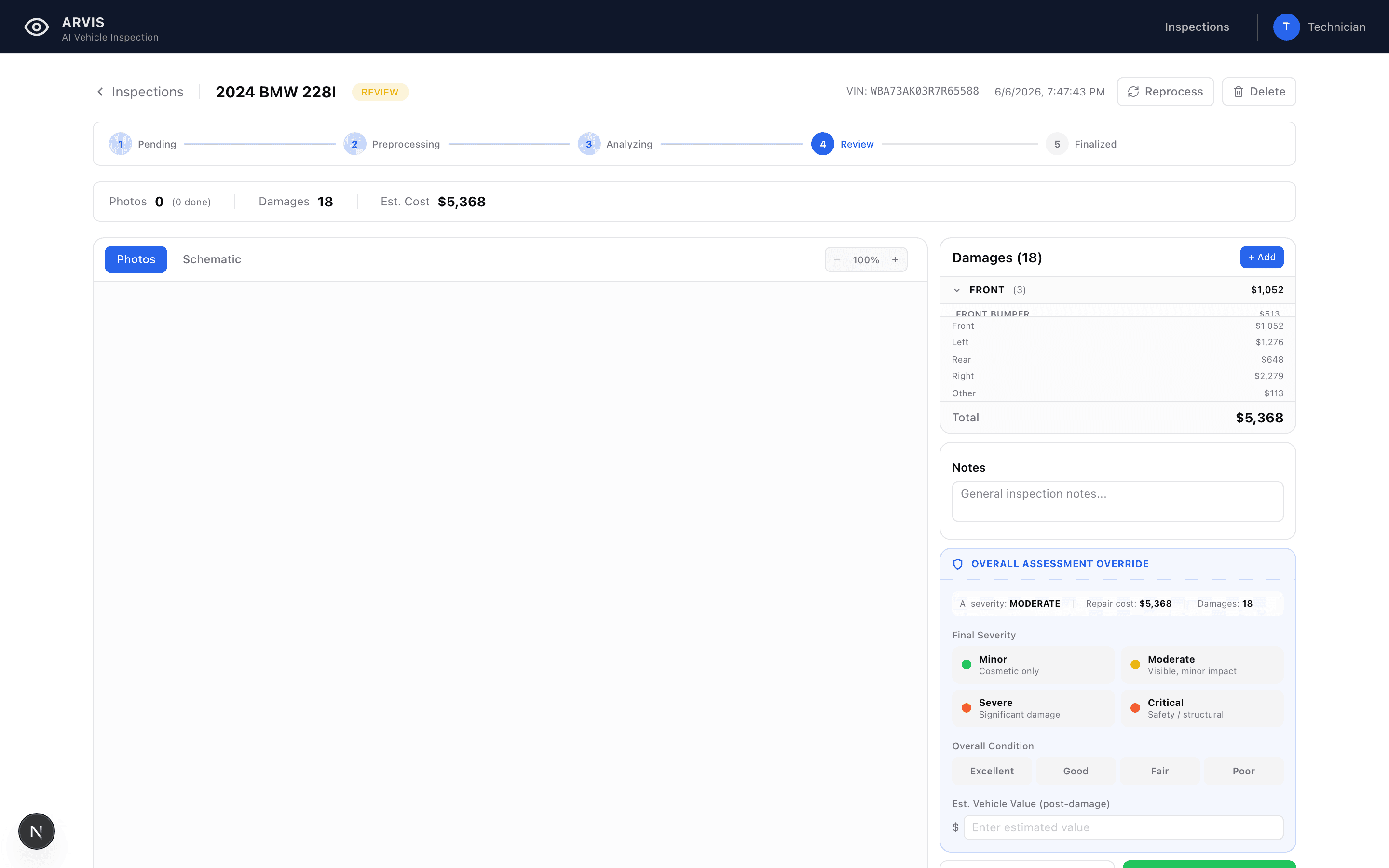
An inspection is a pipeline, not a single guess: photos are preprocessed, each image is analyzed by a vision model, and the findings are consolidated — every damage located on a schematic view (front, rear, left, right, top) with part, type, and severity; repair cost estimated per finding and totaled; the practical facts captured (starts, drives, key count, tire depths, warning lights, announcements). The result reads like a condition report because it is one — and a human technician can review it: adjust severity, add notes, override the grade. The override sits beside the AI's original, never instead of it.
When the scores disagree
They will, and that's the point — three honest signals beat one negotiated number:
- The valuation uses the best available signal (a technician-reviewed ARVIS grade or a third-party report outranks a self-score).
- Buyers see all rows — the spread itself is information. A 4.5 self / 3.5 AI vehicle invites the question a 4.0/4.0 doesn't.
- The CM prices with the spread in view — a wide gap is a prompt to look at the photos before setting the ask.
Worked example
Maria scored the Transit 4.5. ARVIS reads the 12 photos and says 3.5 — it found the rear-bumper scrape (disclosed) plus curb rash on two wheels (not). The uploaded MNH-style report grades 4.0. Alex prices off the spread: the ask stays $32,500, but the listing's condition story now includes the wheels — and when Dan later asks Sakura about condition, the honest answer is already on the record.
Business rules
- ARVIS never runs on an empty photo set — no photos, no AI opinion.
- A technician override shows both numbers (tech grade and AI grade) — overrides are accountable, not cosmetic.
- Reports and inspections stay with the vehicle into the archive — condition history is part of the permanent record.
How Cedar can help here
Cedar treats inspections as source material: ask "what condition issues does this van have?" and the answer cites the ARVIS findings and any third-party report — and Cedar is explicitly instructed to prefer a real inspection over its own quick photo read. Sakura's buyer-side answers draw on the same findings, which is why a disclosed scrape shows up honestly in a marketplace Q&A.
Under the hood
ARVIS is one of the two platform engines (with Orbis) — an inspection pipeline with per-photo analysis, damage coordinates mapped to schematic views, and cost/latency metering per run. Cedar can fetch inspection results in chat, and is explicitly told to prefer a real ARVIS inspection over its own quick photo assessment.