How a vehicle gets valued
The Orbis engine, Black Book data, and Sequoia's market read — where the valuation number comes from.
TL;DRAI summary
This chapter explains how Cypress values a vehicle to help you price it right. You'll see where the valuation number comes from, what makes it change, and how to read the detailed valuation card. This helps you understand the suggested pricing for your vehicles.
For: Fleet Managers · Cypress Managers
Under the lifecycle switch, your Cypress team can run and refresh valuations for your vehicles and re-price against them on your behalf.
Everything done under delegation is logged with a Cypress · on behalf badge and notifies your Fleet Managers. Manage the switches in Settings → Organization → Permissions — the full story is in Delegation — Cypress on your behalf.
Before anyone argues about price, Cypress puts a neutral number on the table. This chapter explains where that number comes from, what makes it move, and how to read the card that presents it.
The stack: an engine below, a specialist above
Orbis is the valuation engine — an app of its own that Cypress calls for every vehicle. With a VIN and Black Book configured, the number comes from Black Book's wholesale channel, adjusted for mileage and condition. Without them, Orbis falls back to its own heuristic so no vehicle is ever unvalued. Sequoia is the specialist that interprets the number: comparable listings, the market trend, and a plain sell-or-hold read, presented as the Sequoia card on the vehicle.
What the card shows
- Wholesale — the headline. This is the number the three-prices ladder anchors on.
- Bands — wholesale above/below and trade-in, when the source provides them; retail-clean appears as the CM's ceiling reference.
- Source badge — Black Book, MMR, or Orbis Heuristic, with provenance (publish date, mileage-at-valuation, condition used). If you ever see "Mock data — not real" in amber, you are looking at fixture data on a test environment — never quote it.
- Staleness — valuations age. A stale badge means the inputs have moved (mileage, condition, or time) and a refresh is due.
What makes it move
A valuation is a snapshot of its inputs. It re-runs when:
- the condition score changes — the tiers map to Black Book's adjustment bands, so a 3.5 → 4.5 move is real money;
- the mileage is corrected materially;
- a batch import lands (imports value in bulk automatically);
- someone asks — Request valuation on the vehicle, or Cedar's
request valuationaction for a set.
The full Orbis report
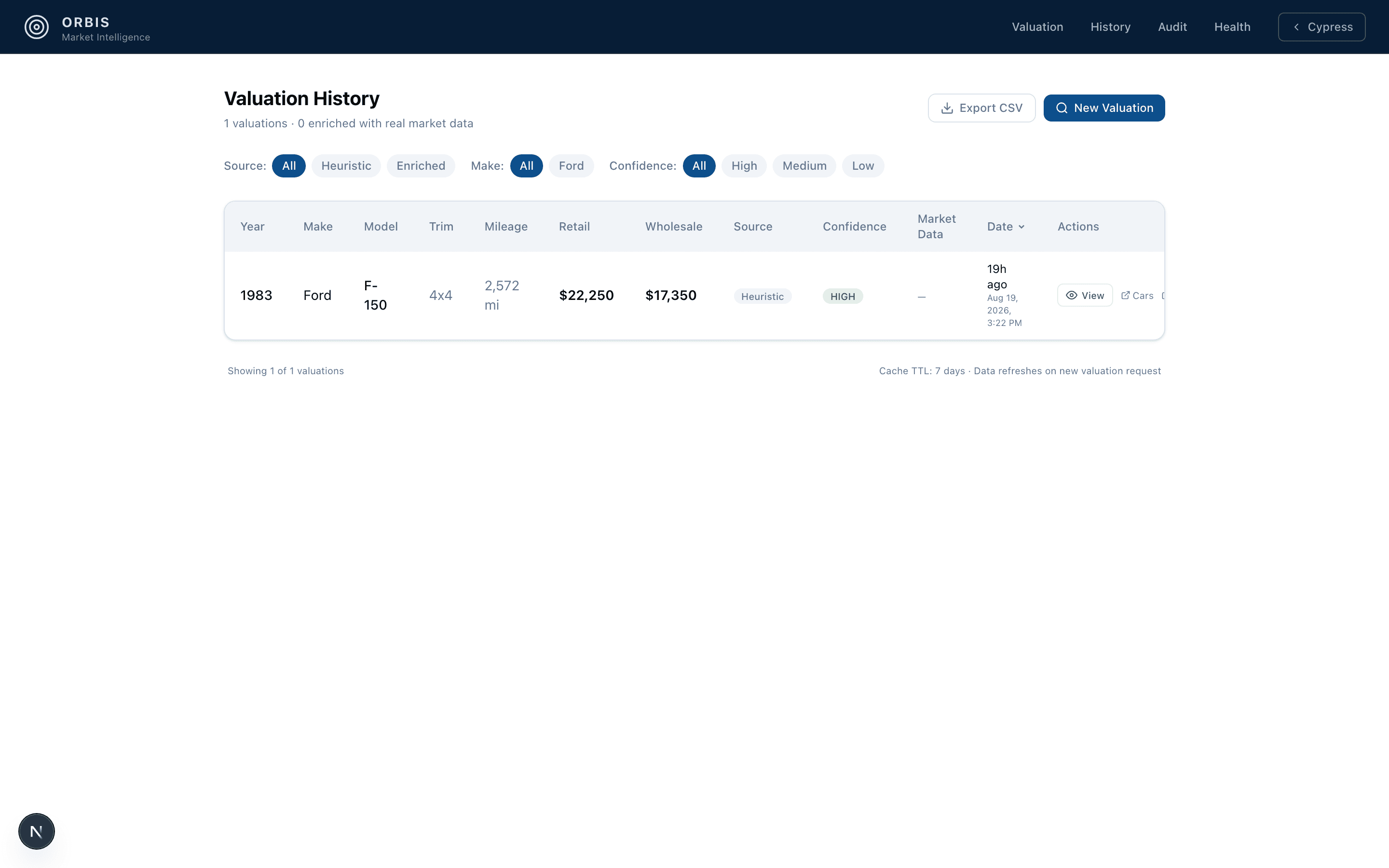
Behind the card sits the Orbis engine's full report — open it with View in Orbis on any valuation. It carries the complete picture: the wholesale/retail/trade-in bands with the above/below spreads, the exact inputs used (mileage at valuation, condition tier, region), Black Book provenance (UVC, publish date, data frequency), and the valuation history so you can see the number move as inputs changed. For deeper market context a CM can trigger live market research — comparable retail listings scraped on demand, deduplicated into a market read (price quartiles, average days on market) that Sequoia folds into its narrative. Research is deliberate and CM-triggered, never an invisible background cost.
The ±% deltas
Wherever the floor and listing price appear, you'll see ±N.N% vs Orbis under each (in the Seller Hub, vs Orbis retail) — the distance between the human numbers and the computed one. Green means priced above the valuation; deep red (below −5%) is the platform's nudge that the number deserves another look. The offer panel's offer check — "Set a floor price to unlock the offer check" — reads offers against those two lines; it is Sell's own rule, not the plan's advice.
Worked example
The Transit (18,412 miles, condition 4.5, Texas) values at $31,400 wholesale from Black Book, trade-in $29,700, published this week. The Sequoia card lists three comparable Transits within 200 miles — $30,900, $31,800, $32,400 — and reads "SELL — cargo vans in this band are trending down ~2%/month; days-on-market rising." Maria floors at $29,000 (−7.6% vs Orbis, shown amber), Alex lists at $32,500 (+3.5%, green). Neither number argues with the valuation — they bracket it, which is what healthy pricing looks like.
Valuing a car you have not added
Cedar answers "what is it worth" for any car, from a VIN or just a year, make and model, and says how sure it is. It tries each source in order and uses the first that has something:
- Black Book, looked up now: with a VIN, while your account has a valuation to spend (an individual's count; a dealer has no cap).
- Black Book's earlier values: of this same VIN in the last 12 months, else of similar cars (same make and model, the nearest model years, similar miles, your state when there are enough).
- What similar cars sold for on Cypress: a range, only when there are at least five sales from at least two sellers.
- A model's estimate from what it knows of the US market.
Every Black Book value, looked up now or earlier, is then set against Cypress's own sales: for cars of the same model (else the same make) sold on Cypress in the last year, Cypress compares each sale price with the car's last Black Book wholesale before the sale. When dealers on Cypress pay, say, 4% over Black Book for that model, the value moves by 4%, and the card shows Black Book's own figure beside it. It takes at least five sales from at least two sellers, so no one company's prices show through.
The value is what a dealer would pay, with its confidence: High, Good, Fair or Rough. It is the lower of what you gave and what the source allows. The most it can be:
| What you gave | Black Book now | Earlier values | Sales on Cypress | Estimate |
|---|---|---|---|---|
| VIN, miles, condition and state | High | Good | Fair | Rough |
| VIN and miles | Good | Good | Fair | Rough |
| Year, make, model, miles and state | needs the VIN | Good | Fair | Rough |
| Year, make and model, with or without miles | needs the VIN | Fair | Fair | Rough |
Earlier values of fewer than three cars count one level lower. Sources that agree make it surer: when another one lands within about 10% of the value (Black Book's value of this car, its values of similar cars, or what similar cars sold for on Cypress), the confidence goes up one level, to High at most for the exact car (its VIN) and Good for a car like it. A model's estimate never counts as agreement, and sales that already moved a Black Book value do not count twice.
A car that belongs to someone else is always given as a range: its own
Black Book figure, its date and its miles are never shown. Cedar's read
on a listing never looks Black Book up, so reading one never spends a
valuation. Below
High, Cedar says what would make it surer: usually the VIN (on the door
jamb or the windshield), the miles, the condition and the state. A
visitor at Grove's front door reads the earlier values, sales and
estimates only; the live Black Book lookup comes with an account. Apps
and agents ask the same with estimate_value.
Business rules
- Valuations are advisory: no rule forces the floor or ask to track them. The deltas inform; humans decide.
- Every Black Book call is metered and logged — valuation spend is real money and shows in the platform audit.
- Deep market research (live scraping of retail listings) is a CM-triggered extra, not part of the standard valuation.
How Cedar can help here
Valuation is where the platform's AI does its most visible work: Orbis computes, Sequoia reasons, Cedar acts. Ask Cedar "is this priced right?" and the answer is Sequoia's — the number in market context, comps cited, sell-or-hold stated. Ask for a listing price and Cedar proposes one anchored on the valuation with the delta shown — a proposal card, never a silent write. Bulk re-valuations are one sentence in Copilot mode. The pattern holds platform-wide: engines compute, specialists explain, Cedar proposes, you decide.
Under the hood
Valuations persist per-vehicle with full provenance (source, UVC, condition
at valuation, publish date) and an isStale flag; the condition tiers map
1.0–5.0 scores onto Black Book's bands exactly as the CSV importer and the
API do. Integrators see valuation-bearing fields on vehicle reads — see the
developer docs.