What Cypress is
The shared mental model: a managed marketplace, four lifecycle stages, and three seats at the table.
TL;DRAI summary
This chapter introduces Cypress as a complete managed remarketing platform that handles everything from valuation to title for your vehicles. You'll learn about the four stages a vehicle goes through, the different user roles, and the AI tools that support the process.
For: Everyone — start here
Cypress is a managed remarketing platform: fleets bring vehicles, buyers bring money, and Cypress operates everything between — valuation, listing, negotiation, paperwork, payment, title. It is not a classifieds board. Every deal has an operator (a Cypress Manager) accountable for it, and every automated decision traces back to consent a human gave in advance.
The four stages
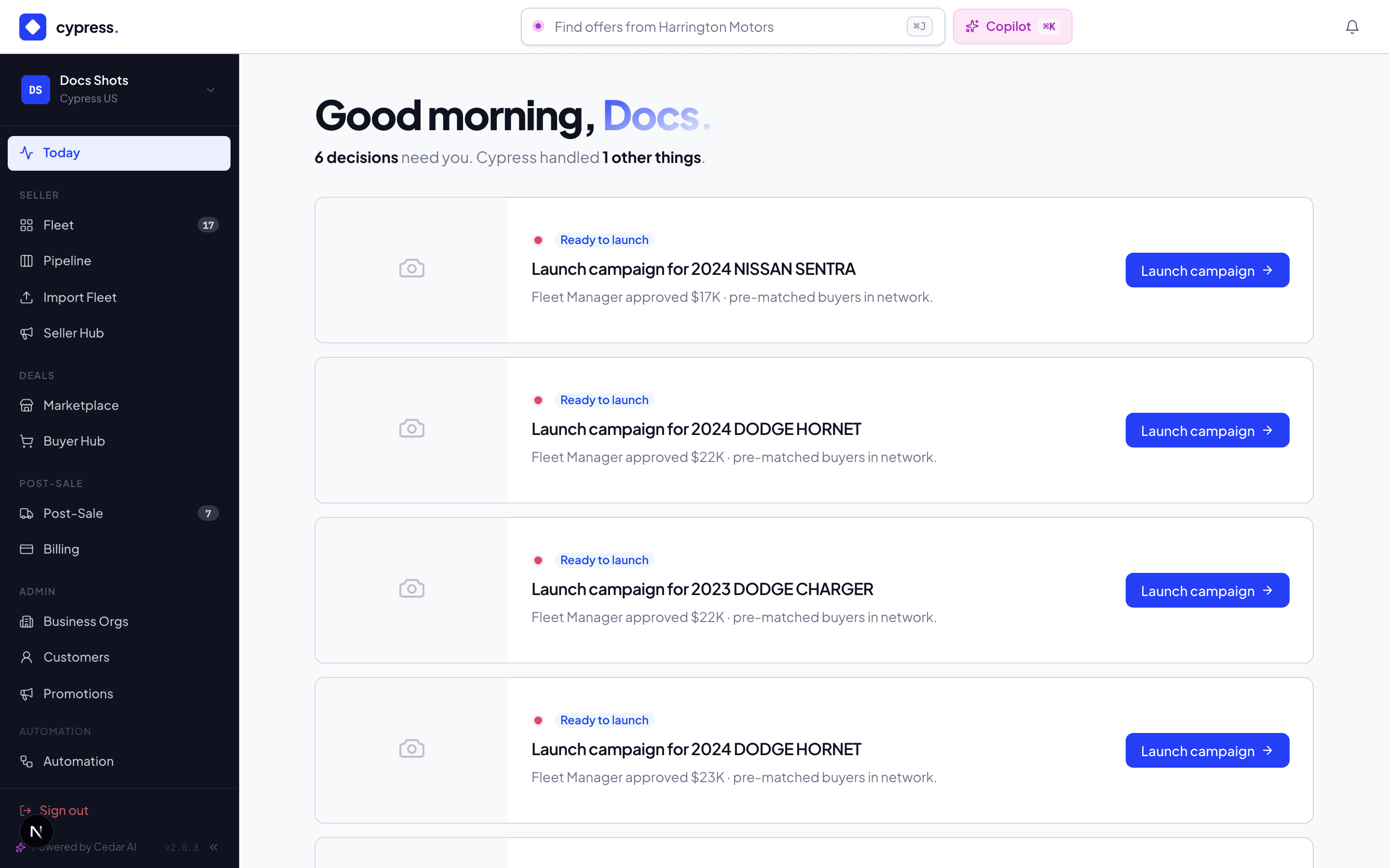
Every vehicle on the platform is in exactly one of four lifecycle stages — the app, the hubs, and Cedar all speak in these and only these:
- Onboarding — the vehicle enters: identity (VIN), condition, photos, and the seller's floor price.
- Pre-listing — the platform prices it: valuation computed, listing price proposed and approved, launch checklist cleared.
- Sale — it's live: channels, engagement, offers, negotiation, and an acceptance.
- Post-sale — the deal completes: the 6-step closing, payment, title, pickup — and then the archive keeps the record.
The landing page diagram draws the ribbon; the Pipeline page in the app is the same four stages as a kanban you can drag.
Three seats at the table
- The seller (a business org): its Fleet Manager owns the fleet, the floor price, and the final consent on every below-floor decision. Org admins manage settings, team, integrations and the apps the organization connects; billing admins own the money pages. An app the organization connects may add agents to the team, AI workers that hold tasks under the rules for agents (Apps, agents and MCP).
- The Cypress Manager (platform staff): prices, launches, screens offers, runs closings, and governs changes. When this manual says "CM", it means the platform operator seat.
- The buyer: a dealer or wholesaler org — or an individual with a consumer account — browsing the marketplace, storefronts, and direct links, making offers, and completing purchases.
One rule ties the seats together, and the whole manual keeps returning to it: the floor is a promise — nothing sells below the seller's floor without the seller's explicit consent.
Meet the AI team
Five names appear throughout the product:
- Cedar — the fleet advisor and orchestrator. It reads your screen, answers questions, and proposes actions — nothing runs until you confirm.
- Sequoia — market intelligence: valuations in context, comparables, sell-vs-hold.
- Sakura — sales: listing readiness, buyer-side answers on the marketplace.
- Sapele — closing compliance: reads deal documents and flags problems before they cost anyone money.
- Orbis and ARVIS are the two engines behind them — valuation and photo-based damage inspection. You don't talk to engines; the agents and the app do.
Cedar & the AI team is the full chapter.
The Transit, in four sentences
Throughout this manual one deal recurs. Acme Fleet Services onboards a 2022 Ford Transit 250 — condition 4.5, floor $29,000. Orbis values it at $31,400; Alex (CM) lists at $32,500 on the marketplace and Acme's storefront. Dan at Birchwood Logistics offers $28,200, negotiates to $29,200, and both approvals land. The 6-step closing runs — check payment, 10-day hold, title by FedEx — and the Transit rests at SOLD, the sale counted in Acme's permanent record.
Every chapter picks up this story exactly where the previous one leaves it.
Where to next
- Selling? Start with your fleet, then the three prices.
- Buying? The marketplace.
- Operating? Roles & navigation, then the governance chapters.
- Integrating? The developer docs are their own section.