Blockers & readiness
What can stop a sale (and what can't stop planning), and how readiness is four checks — never one score.
TL;DRAI summary
This chapter explains how blockers prevent vehicles from being sold until specific issues are resolved. It also covers "readiness," a single status that summarizes four behind-the-scenes checks to ensure a vehicle is ready for its next step, from scheduling to sale.
For: Sellers · Cypress Managers
Blockers gate selling — never planning
A blocker says: this vehicle cannot be sold until X happens. A stale payoff statement, a disputed odometer or missing inspection, replacements not yet in service, a missing approval. You can analyze, rank and schedule a blocked vehicle freely; the consequential step is what waits.
The kinds behave differently: a payoff or arrivals blocker schedules a vehicle as waiting — it rides its window and hands off when the evidence lands. A disputed-evidence blocker is stricter: it takes the vehicle out of every ranking and proposal entirely, because a disputed mileage denominator taints every derived number. In a lot, blockers are counted by kind so you see at a glance how many of the fifty wait on a payoff.
In the vehicle panel blockers are a small table — kind, what gates the sale, since when — with three actions per row: edit the kind or the note while it is open, resolve it by naming the evidence, or remove it with a reason (added to the wrong vehicle, duplicated). Each is confirmed inline before anything writes, and each is recorded with its reason and re-evaluates the vehicle on the spot — resolve or remove the last one and watch the vehicle return from waiting to scheduled, with the plan's history saying why. Resolution names its evidence: the panel asks what cleared the blocker (a document, an order id, an inspection) and stores it with the resolution — never a timestamp token. A resolved blocker is history: it can be neither edited nor removed.
Readiness — one word, four checks behind it
The vehicle panel says readiness in one line: Ready to schedule, Ready — hand to Sell by Oct 1, Waits on payoff at sale, Blocked: odometer disputed, Parked until Q1 2027, In Sell — being prepared. Beside it, how solid the inputs are: "25% of the inputs behind these numbers are verified or connected — mostly class baselines". The word comes from four separate checks kept behind a disclosure: evidence (is the data good enough?), feasibility (does the fleet still work?), authority (who approved exactly this?), execution (what actually happened?). They are evaluated per action, for the action the vehicle's status implies: candidates gate scheduling, scheduled rows gate the hand-off to Sell, handed-off rows gate the sale. A payoff gap doesn't stop scheduling; it stops the sale. Everywhere a vehicle appears — its panel, the Vehicles tab — it reads as one word: "Ready to schedule", "Waits on payoff at sale", "Failed to sell in W39–40 · Ask 21% above plan value". The four checks behind it open from the vehicle panel.
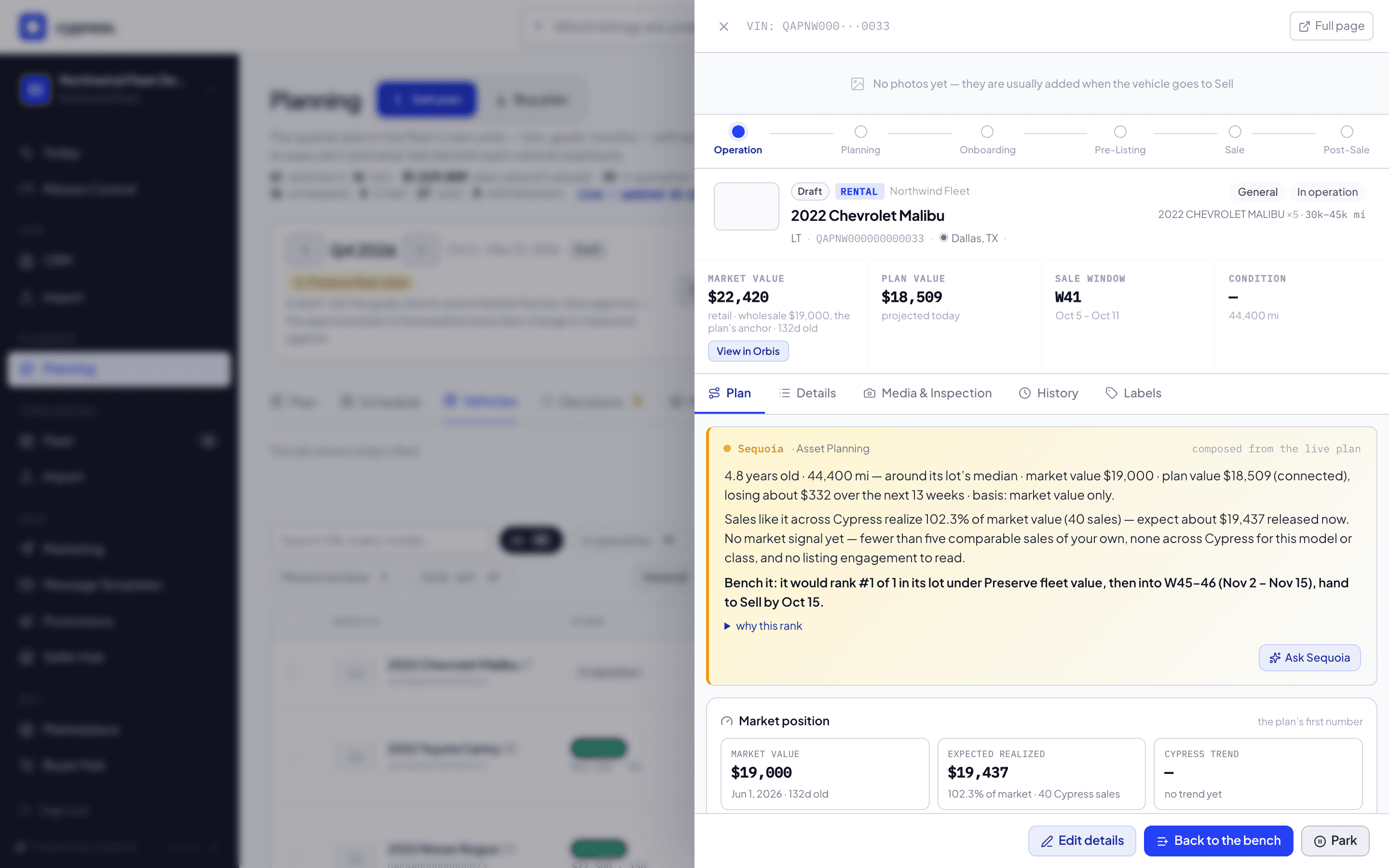
Beside readiness sits evidence coverage (HIGH / MEDIUM / LOW): the tier mix of the inputs driving the recommendation. It is deliberately not calibrated confidence — uncertainty lives in the value projection, and the four checks gate what may actually happen.
The plan — goals, lots, and the quarter
Planning in the fleet's own units: a quarter plan with goals and monthly targets, lots of same-model vehicles cut into mileage bands, and how the plan stays live while an approval keeps a baseline.
The schedule, the hand-off, and what actually happened
Sequoia's proposal into the six windows, handing a window to Sell by its date, the read-only execution mirror with the shortfall ladder, and the reviews the plan learns from.