Copilot mode
Cedar takes the wheel of your current screen — the Bar, the orb, the Work Surface, and how a session actually flows.
TL;DRAI summary
This chapter explains Cypress Copilot mode, where an AI assistant helps you manage tasks on your screen. It understands your context, suggests actions, and shows you everything it does before you confirm.
For: Everyone — this is the agentic platform at full volume
Cypress is agentic-first: the assistant isn't a chat window bolted to the side, it's a co-driver for the screen you're already on. ⌘K engages Copilot mode. This chapter is the full tour.
The stage
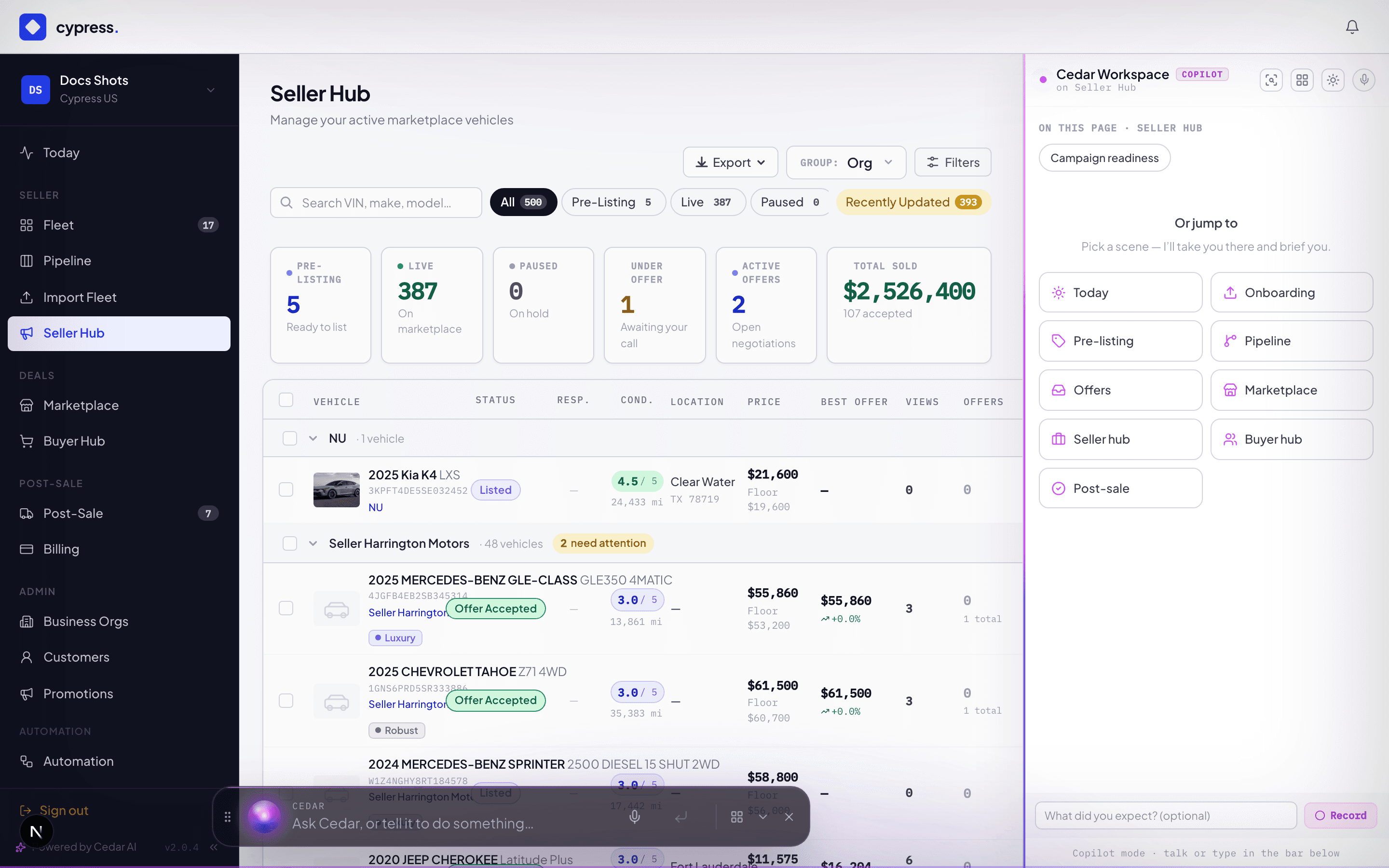
When Copilot engages, the app rearranges around the conversation:
- The Cedar Bar docks (drag it to any edge) carrying the conversation and the orb — Cedar's state at a glance: breathing when idle, pulsing while listening, swirling while thinking, pumping while speaking. Voice can auto-start; the orb always tells you when the mic is live.
- The Work Surface opens alongside, with three lanes:
- Proposals — every write Cedar wants to make, as cards showing the exact change, waiting for your confirm.
- The step trace — each tool call as it runs, live. You watch the work happen instead of trusting a spinner.
- Result cards — answers rendered to fit: a valuation card, a fleet summary, an inspection readout, an appraisal.
- The rest of the app dims slightly — sport mode. Esc hands the wheel back instantly, exactly where you were.
What "reading your screen" means
Copilot knows the room you're in and briefs itself on entry: land on Post-Sale and it opens with what's waiting on you; switch to the Seller Hub and its context is your grid — current filter, selection, sort. With a vehicle panel open it binds to that vehicle, so "value this one" or "draft a counter here" cannot hit the wrong car. On the Buyer Hub, the grid it reads is offers.
And it drives: navigation, filters, row selection, the bulk bar, exports — all tool calls you can watch in the trace.
A session, end to end
Maria, Monday morning, Seller Hub open. ⌘K.
"What needs me today?" — Cedar briefs: two offers in review, one counter expiring at 3pm, three vans stale past three weeks.
"Show the stale ones." — the grid filters itself; three rows.
"Ask Sequoia if we should cut prices." — a market card per van: two say hold (segment trending up), one says cut.
"Cut that one 4% and pause the oldest." — two proposal cards appear: a price change with the new bands and Sequoia delta, and a pause. Maria confirms both. The trace shows each apply; the Activity tab records automation (confirmed by Maria).
"Remind me about the counter at 2." — done. Esc. Four minutes, nothing left hanging.
The specialists on the surface
Copilot is Cedar orchestrating; the specialists surface as the cards: Sequoia for anything market ("is this priced right?"), Sakura for selling and buyers ("which channel for this van?"), Sapele when the room is a closing ("any problems in these documents?"). Ask in plain language — routing is Cedar's job, not yours.
Trust, always-on
Copilot mode changes volume, not rules:
- Reads are free; writes are proposals. Nothing mutates without your confirm — money and legal actions always card, even mid-flow.
- Your permissions, not the agent's. Copilot proposing a launch to someone who can't launch goes nowhere.
- Everything lands in the audit trail as automation with you named as the confirming human.
- Esc is sacred — one key, wheel back, no cleanup.
For teams with mixed comfort levels
The copilot is opt-in by design: the whole platform works classically — every button, grid, and form exists without Cedar. A new hire can click through the app on day one and adopt the copilot on day thirty; a power operator can live in ⌘K. Both are first-class. The generational on-ramp is that there isn't one: nothing to learn before the first question, and the first question can simply be "what does this screen do?"
Under the hood
One Cedar brain serves the omnibox (⌘J), Copilot (⌘K), Telegram, and voice — capability-gated per channel, with proposals persisting server-side so a confirmation from any surface resolves the same action. Bounded steps per turn; deliberate refusals over silent guesses.